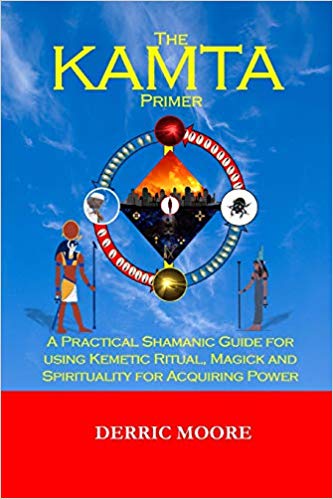
Kamta (also referred to as Kamta Kemetic Shamanism) is a contemporary, spirit-led African-American shamanic path. It was developed and popularized by author, teacher, and spiritualist Derric “Rau Khu” Moore.
The system came about from Moore’s own spiritual crisis and health issues. He was seeking healing beyond his strict Christian upbringing, so he mixed together Kemetism (the modern revival of ancient Egyptian spirituality), practical shamanism, Bantu-Kongo philosophy, along with Conjure, Rootwork & Hoodoo, and Espiritismo Cruzado (Crossed Spiritism) traditions.
The most important part of Kamta is honoring your aakhu (family ancestors and spirit guides) because they assist us with health, love, prosperity, and all family concerns. But more importantly, our aakhu are our first responders that bridge us to other spirits associated with the netcharu.
Unlike traditional religions that might turn to saints or gods in prayer, Kamta teaches that guardian spirits commonly known as the netcharu (netjeru) are not gods and goddesses but are a hierarchical group of spirits assigned and organized to specific tasks based on their spiritual development and spiritual function during their earthly lives.
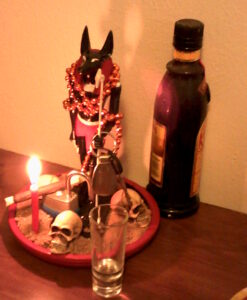
For instance, the first Npu (Anubis) may have lived thousands of years ago in Kemet, which makes them distant to most people. Thankfully, since then there are numerous Npus that exist as a commission of crossroad and gateway spirits (Npu altar shown above).
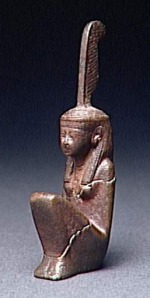
The Kemetic (Ancient Egyptian) term for balance, law, righteousness, holistic, and truth is Maa, who was personified as the netchart Maat (Ma’at), who is depicted in Kemetic art as a woman wearing an ostrich feather headdress; sometimes she has wings and is carrying a scale. In contemporary times, Maat is depicted as the Lady of Justice. This is the technical definition of Maa.
The spiritual definition of Maa refers to aligning yourself with the Absolute Truth, which governs the universe. Since we are all unique beings with different backgrounds and experiences, our personal truths differ from one another on a surface level but align with the Divine grand scheme of things because Maa is Purpose and is similar to the Chinese Tao or the Way.
Therefore, the Maa is balance, law, righteousness, holistic, and the truth, which gives purpose and shows the way. The Maa is the path and the journey. Each one of us have our own individual paths, journeys, roads, truths, (unwritten) laws we must abide by, magickal/spiritual ways we connect to the Source, etc. or maa (lowercase ‘m’) that aligns us with the Maa.
Please note that the opposite of “maa” is “isfet,” which means chaos, confusion, falsehood, violence, and injustice.
Yes, “magick” or “heka,” which means “spiritual power,” is practiced in Kamta. Magick, or heka, is very different from the magic practiced in Hollywood or Western spellcasting because, for one, it was viewed as the fundamental energy that sustains the universe. This means that according to Kemetic belief, magick and science were not seen as separate but as unified parts of a unified worldview. This is the reason Heka was used by the priesthood, physicians, and common people through amulets, charms, rituals and spoken spells to maintain the balance, heal the sick, and protect against malevolent energies.
This means you don’t summon magick from an external source because Heka is already within you. You simply need to learn how to direct this divine force and use it as a tool to create real changes in your life. This means removing the subconscious blockages that are preventing you from performing Heka.
Heka is practiced sympathetically, for instance, physical items are placed on the ancestral shrine (like cold water, specific herbs, or stones) as earthly physical anchors to represent and attract spiritual realities.
Although the ancient Kemetic people did not have a word for malevolent magick, witchcraft is defined as using Heka out of alignment with Ma’at because it creates isfet (chaos, confusion, etc.), and is associated with the netchar Set.
The truth is that we have all been duped into believing that African spirituality is evil because in the late 1700s on the island of Hispaniola. Enslaved Africans used the Vodun religion to rebel against slavery, which led to Haiti winning its Independence in 1804. Ever since then, everything that was African was demonized and depicted as being anti-Christian. The fact is that I have never seen a Christian leave a Chinese buffet or an East Indian restaurant, which proudly showcases their ancestors, spirits, gods and goddesses, but are quick to withdraw support and/or boycott Afro Diaspora businesses that display their faith. Is proof of this cultural bias.
No. Not according to my experience. If this was the case, good people would not be misused and treated badly. The reason they are is because Kemetic Spirituality is really about Spiritual Power and has little to do with being good.
Technically, there is no such thing as good and evil because they are both relative. What is good for one person can be bad or evil for another. A prime example of this is slavery, which was good and selfishly benefited slave owners only, but was a great evil for everyone else. It is best to use the Kemetic terms maa (balance, truth, righteous, etc.) and isfet (imbalance), which reflects all who are involved. If something is maa (balanced), it brings peace, prosperity, wellbeing and power to everyone. If something is isfet, it selfishly only benefits and empowers a minority.
So “good people” are misused and taken advantage of because they lack a sufficient amount of spiritual power. This explains the reason why Osar (Asar, Osiris) who was good but naive was murdered by his younger brother Set. See the Kemetic Story here.
There are numerous theories that exist so it is matter of picking which one suits you. But, to be honest with you, everything that exists in our Universe cannot be explained scientifically using modern science. Some things are based upon faith and knowing. My understanding of this phenomena is that our soul (Ab) is eternal. So when we physically die, our Ab (thoughts, ideas, etc.) continues to exist as a spiritual being or spirit. Thus, there are numerous spirits that exist but the spirits that have the most influence in our lives are the spirits of the dead because we remember them the most and they are familiar with this life.
If this was the case, then many of the miraculous events that occurred in the bible where angels intervened would never have occurred because angels are spirits. The truth is that we rub shoulders with all types of spirits. The spirits that latch on to us are the ones whom we can help, and the ones who can help us. So-called evil spirits only gravitate towards people who are involved in evil, low vibrational, Setian or isfet (imbalanced) activities like adultery, theft, violent crimes, murder and anything symbolized by Set (See the Kemetic Story of Osar). In other words, it is not true that the “devil (or some other entity)” made you do something against your will. If it was in your Ab (soul/heart) to do ill against another. All the spirit did was give you the encouragement and inspiration but you are not compelled to follow any spirit. You are made in the image of the Divine, which means you have free will.
The simple answer is that we appreciate more what we earn. This was a ‘thing’ that was weaved into our spirit the day humankind received an Ab soul. Consequently, anything given to us freely is typically not appreciated, abused and misused. When we have to earn some thing, we appreciate it more. Paying for books and other services is an extension of earning what we want.
Most traditional Kemetic systems usually center around reconstructing the Kemetic religion of old by focusing on the temple rituals, the priesthoods, and the old Kemetic calendar. But Kamta’s is different in the sense that it focuses primarily on African shamanism.
For instance, in most Kemetic-inspired religions, the Netcharu (Netjeru, the Egyptian divinities) are viewed as far-off gods and goddesses that you worship. But in Kamta, the Netcharu are viewed as deified ancestors—specifically guardian spirits/spirit guides—that have become cosmic principles associated with natural laws and inner archetypes that anyone can connect with to change their life.
In Kamta, Maa is the principle of cosmic order, justice, truth, and balance and is personified by the netchart Ma’at. While practitioners in most Kemetic religions observe Ma’at by living honestly, fostering kindness and harmony with others, and getting ready for the ultimate judgment in the afterlife. Kamta takes a different approach to living in harmony with Ma’at through a worldview centered on reciprocity and interconnectedness. In Kamta, the Maa Aankh cosmogram is used as the philosophical framework that maps the universe into four quadrants, representing the four moments of Ra (or the Kemetic sun), the four stages of life, and the ongoing, soulful adventure we all share as we move back and forth between the physical world and the spiritual realm.
Living in Harmony with Ma’at Simply Means:
If something is taken, then something must be given back in return; this is Maa. because we—plants, animals, water—are all interconnected.
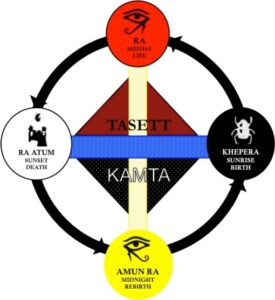
A central teaching tool in Kamta is the Maa Aankh cosmogram. This is a unique spiritual cosmogram that draws from the Central African Dikenga dia Kongo cosmogram but is based upon Kemetic concepts and principles. The Maa Aankh cosmogram maps out the following:
- The cycle of birth, life, death, and rebirth.
- The relationship between the physical realm (Tasett or the red land/lower self) and the spiritual realm (Kamta or the black land/higher self, representing the fertile ground of spiritual power).
- Navigating the human soul’s journey in alignment with Ma’at (truth, balance, cosmic order).